What if my prediction turns out to be wrong?
It cannot cost you a single point. Raters score how clearly and logically you speak, not whether the future you describe would really happen. A grounded guess delivered smoothly is a complete answer.

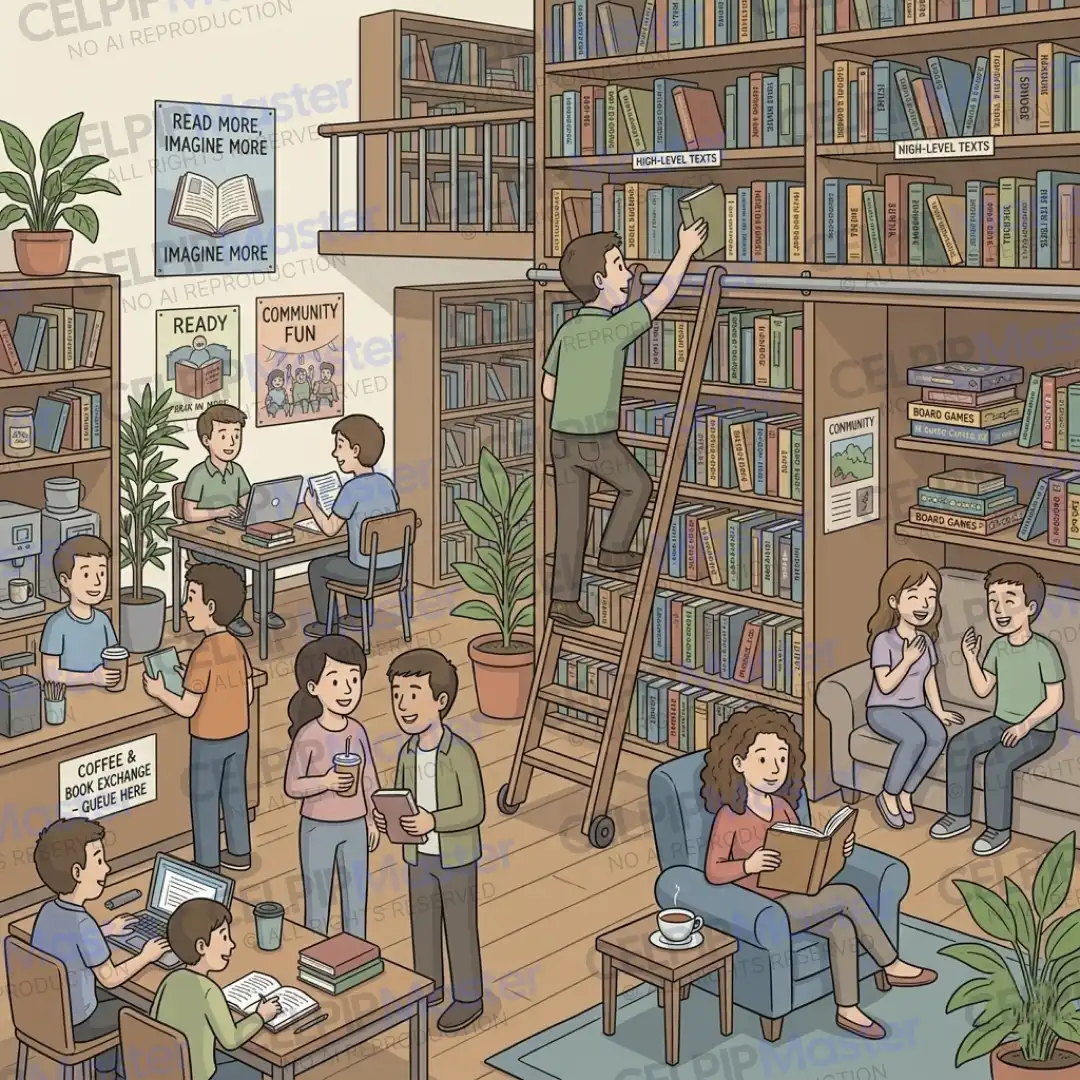
In Task 4 the same picture from Task 3 comes back, but the job changes from describing to predicting. You get 30 seconds to prepare and 60 seconds to say what you think will happen next. Raters are not judging whether your predictions come true, they are judging how clearly you connect each guess to something visible in the picture. The demo above uses the exact interface and timing of the real test, so everything you practice here transfers directly.
Trained raters score every CELPIP speaking task on the same four equally weighted dimensions. Here is what each one rewards when the task is prediction.
How well your ideas are organized and developed. Two or three predictions with clear reasons, in a logical order, beat a rushed tour of everyone in the picture.
Range and precision. Words that pin people down, like the man on the ladder or the woman in the pink top, do more for this score than any rare idiom.
Rhythm, pronunciation, intonation, and grammar together. Future forms are graded here, so mixing will, going to, and might shows more range than repeating one form perfectly.
Did you actually predict, in answer to the question, for the full 60 seconds? Drifting back into describing the scene loses more points here than any grammar slip.
Pick two or three people whose next move is easy to guess, and note the visible clue behind each guess. When the 30 seconds run out you hear a loud "Start speaking now" and recording begins immediately, there is no button to press.
Open with one sentence that points at the future, something like over the next few minutes a lot is going to change here. That is all the scene setting you need, re-describing the picture is Task 3.
Name the person by clothing or position, say what they will do next, then give the visible reason with because or since. The clue is what turns a guess into a prediction.
End with where the scene is heading overall, so the answer sounds finished on purpose. Stopping mid-prediction when the timer runs out reads as an incomplete response.
Each phrase signals a different level of confidence, and raters listen for exactly that variety. Practice all four until the right one comes out on its own.
Replaying your Task 3 answer is the most common Task 4 mistake. One anchor sentence, then every sentence looks forward.
One future form on repeat caps your grammar range. Rotate in going to, might, and about to as your confidence shifts.
A prediction without a visible reason is just a guess. Tie each one to something you can point at in the picture.
The question asks what will most probably happen. A fire alarm or a celebrity walking in reads as off task, keep predictions ordinary.
Hedging every prediction with the same word caps your range. Swap in probably, likely, or could the second time you hedge.
It cannot cost you a single point. Raters score how clearly and logically you speak, not whether the future you describe would really happen. A grounded guess delivered smoothly is a complete answer.
No, description is exactly what raters mark down in Task 4. Give one anchor sentence for context, then keep every sentence in a future form so the whole answer counts as prediction.
Mix at least three, and let will, going to, and might carry most of the answer. Match the form to your confidence, going to for something clearly building, will probably for a reasonable guess, might for a long shot. Raters hear that variety as grammar control.


