Do I have to describe everything in the picture?
No, and trying to will cost you points. Choose four or five clear elements, give each one a location, an appearance detail, and an action, and let the rest of the picture go.

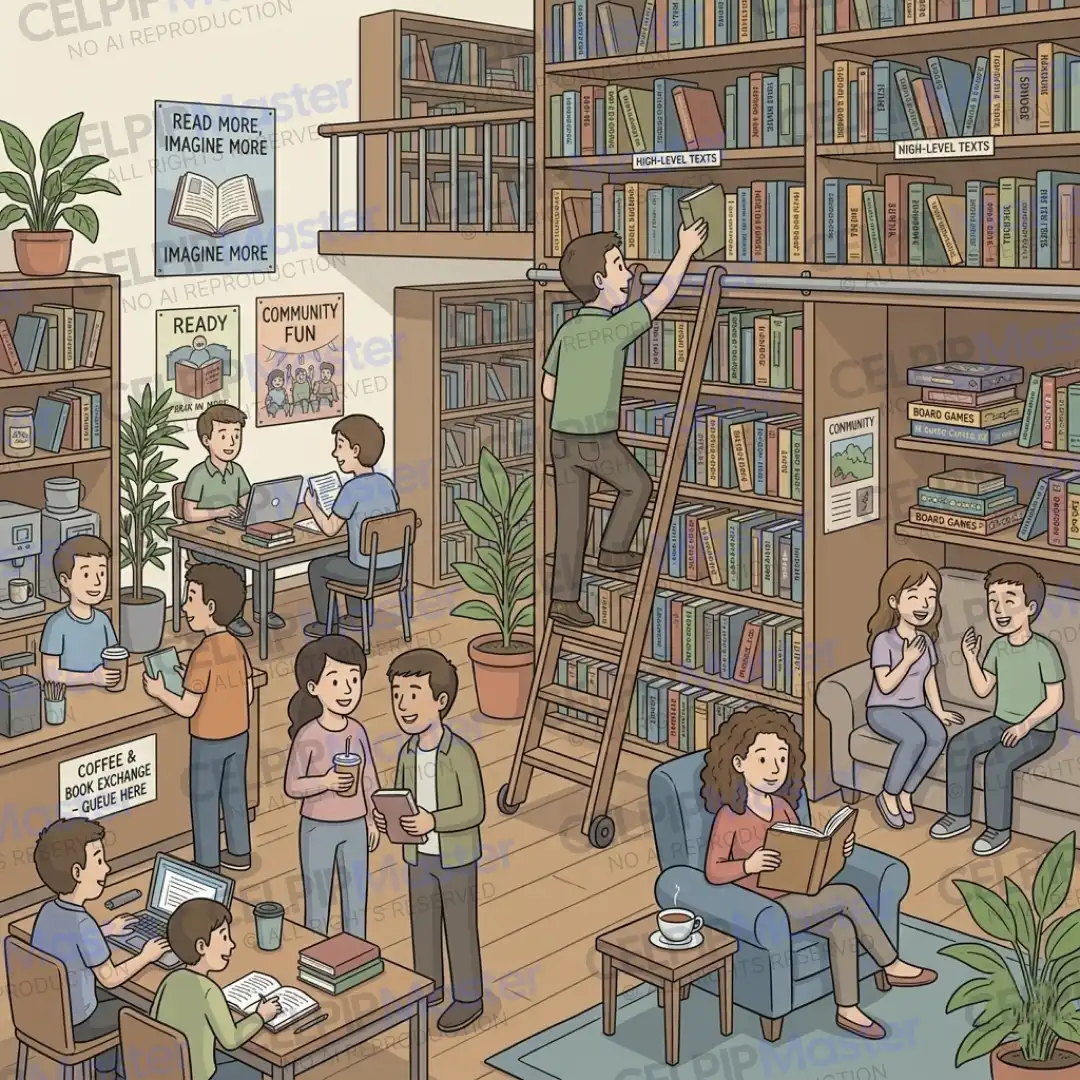
In Task 3 the screen shows a detailed picture of an everyday scene, and your job is to describe it to someone who cannot see it. You get 30 seconds to prepare and 60 seconds to speak. Raters are not testing your imagination, they are testing whether your words alone let a listener rebuild the scene. The demo above runs on the exact interface and timing of the real test, so everything you practice here transfers directly.
Trained raters score every CELPIP speaking task on the same four equally weighted dimensions. In Task 3 each one rewards a specific describing skill, which makes the points unusually easy to aim at.
Whether your details add up to one scene the listener can follow. A single clear route through the picture scores better than a pile of unconnected observations.
Range and precision. Spatial phrases like in the foreground plus exact verbs like reaching and chatting show more range than any rare idiom would.
Rhythm, pronunciation, intonation, and grammar working together. In Task 3 that mostly means keeping present continuous steady, a man is climbing, not a man climb.
Did you actually describe this picture, in enough spoken detail that a listener could sketch it? Drifting into opinions about the topic loses more points here than any grammar slip.
Scan the picture and choose a route: the overall setting first, then four or five people or groups to cover along the way. When the 30 seconds run out you hear a loud "Start speaking now" and recording begins immediately, there is no button to press.
Name the kind of place and the overall feel in one or two sentences, like a bright, busy public library. That frame lets the listener place every detail that follows.
Move in one direction, foreground to background or left to right, and give each person a location, an appearance detail, and an action in present continuous. A fresh spatial phrase signals every move.
End with one small specific detail or a sentence about the atmosphere so the answer sounds finished on purpose. Getting cut off mid-sentence by the timer reads as running out of language.
Each phrase tells your listener where to look before you say what is happening there. Open every new part of the description with one and the scene builds itself in order.
Describing whatever you notice next forces the listener to rebuild the scene after every sentence. Pick one route through the picture and follow it.
A man climb, or a sudden jump into past tense, is the easiest error for raters to hear. The actions are happening now, so keep them in is doing form.
Some people are doing something gives the rater nothing to score. Name the clothing, the object, and the exact action instead.
Racing through a dozen items leaves no room for detail and your delivery falls apart. Four or five well-described elements beat a complete inventory.
This person or over here means nothing to someone without the picture. Anchor every detail with a spoken location like on the left or near the back.
No, and trying to will cost you points. Choose four or five clear elements, give each one a location, an appearance detail, and an action, and let the rest of the picture go.
Describe around it and keep talking. A tool for reaching the top shelves works fine when ladder will not come to mind, and raters reward a smooth recovery far more than they punish a missing word.
Yes, Task 4 shows the same picture and asks what will happen next. While you describe the scene here, quietly note one action in progress, like someone reaching for a book, and your Task 4 prediction is already made.


